
Your Cart is Empty

If you live with joint, muscle, or nerve discomfort, you’ve probably been told some version of this:
“Just take something and power through.”
And for a lot of people, that means pills or powders — sometimes several a day — hoping relief eventually kicks in.
But here’s a question most people are never asked:
If your discomfort lives in one place… why is all your support spread everywhere else?
This isn’t about saying supplements are bad or that one approach is “wrong.” It’s about understanding how the body experiences discomfort — and why targeted, consistent care often makes a bigger difference than doing more.
Most of the discomfort people deal with doesn’t start in the whole body at once.
It starts in a specific area:
A stiff knee that complains after walking
A burning foot that wakes you up at night
A lower back that tightens after sitting too long
Hands that ache when the weather changes
Whether it’s joints, muscles, or nerves, the body is usually very clear about where it needs help.
That area becomes guarded. Tight. Sensitive. Less willing to move the way it used to.
And when movement feels uncomfortable, people naturally compensate — shifting weight, avoiding certain motions, pushing through when they shouldn’t.
Over time, that can turn a small problem into a bigger one.

When discomfort sticks around, most people respond by doing more:
Another pill
A higher dose
A different supplement
A new routine they struggle to keep up with
But more support doesn’t always mean better support.
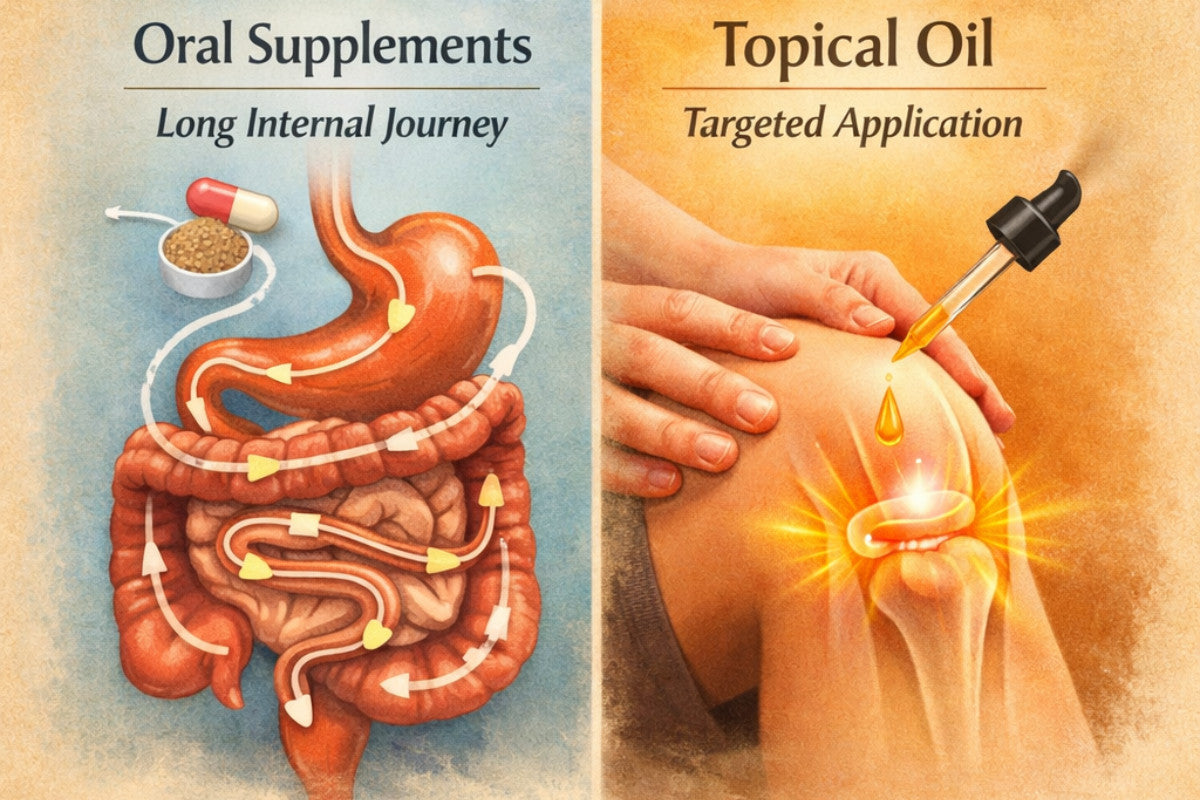
Oral solutions — pills and powders — have to be digested, processed, and distributed throughout the entire body. That can take time. And you don’t get to choose exactly where that support shows up.
That’s not a flaw — it’s just how the body works.
The issue is that when discomfort is local, whole-body support can feel unfocused.
You’re helping everything… and sometimes the exact spot that hurts still doesn’t feel addressed.

Targeted care works with the body’s signals instead of ignoring them.
When you apply support directly to an area that’s uncomfortable, you’re doing a few important things:
You’re acknowledging where the body is asking for help
You’re supporting circulation and movement in that area
You’re creating a physical connection with the spot that needs care
For many people, that alone brings reassurance.
It feels proactive. Intentional. Personal.
Instead of hoping relief shows up eventually, you’re responding directly to what your body is telling you right now.
One of the biggest misunderstandings about mobility and comfort is that relief has to come from big, dramatic actions.
In reality, the body responds best to small, consistent support.
Think about it like brushing your teeth.
You don’t brush once a week for an hour. You do it briefly, every day, because consistency protects you long-term.
Daily, targeted care works the same way.
A simple routine — applied regularly — can help:
Maintain flexibility
Reduce stiffness over time
Support comfortable movement
Build confidence in your body again
It’s not about chasing flare-ups.
It’s about supporting your body before discomfort decides how your day will go.

As the years go on, the body doesn’t always bounce back the way it used to.
That doesn’t mean giving up.
It means being smarter and kinder with how we support ourselves.
Targeted, daily care respects that reality.
It says:
“I’m not trying to push through my body.
I’m trying to work with it.”
That mindset shift alone can change how people move, rest, and feel — not just today, but years from now.
If discomfort shows up in one place, that place deserves attention.
You don’t need more solutions.
You need the right kind of support, applied consistently, where it matters most.
Later this week, I’ll share how I personally approach daily, targeted care — and why keeping it simple has made such a difference for me.
Until then, listen to what your body is telling you.
It’s usually wiser than we give it credit for.
— Mark
Norma Heikkinen
January 27, 2026
I love your products I suffer with a lot of pain. But financially I can’t afford to buy it.