
Your Cart is Empty

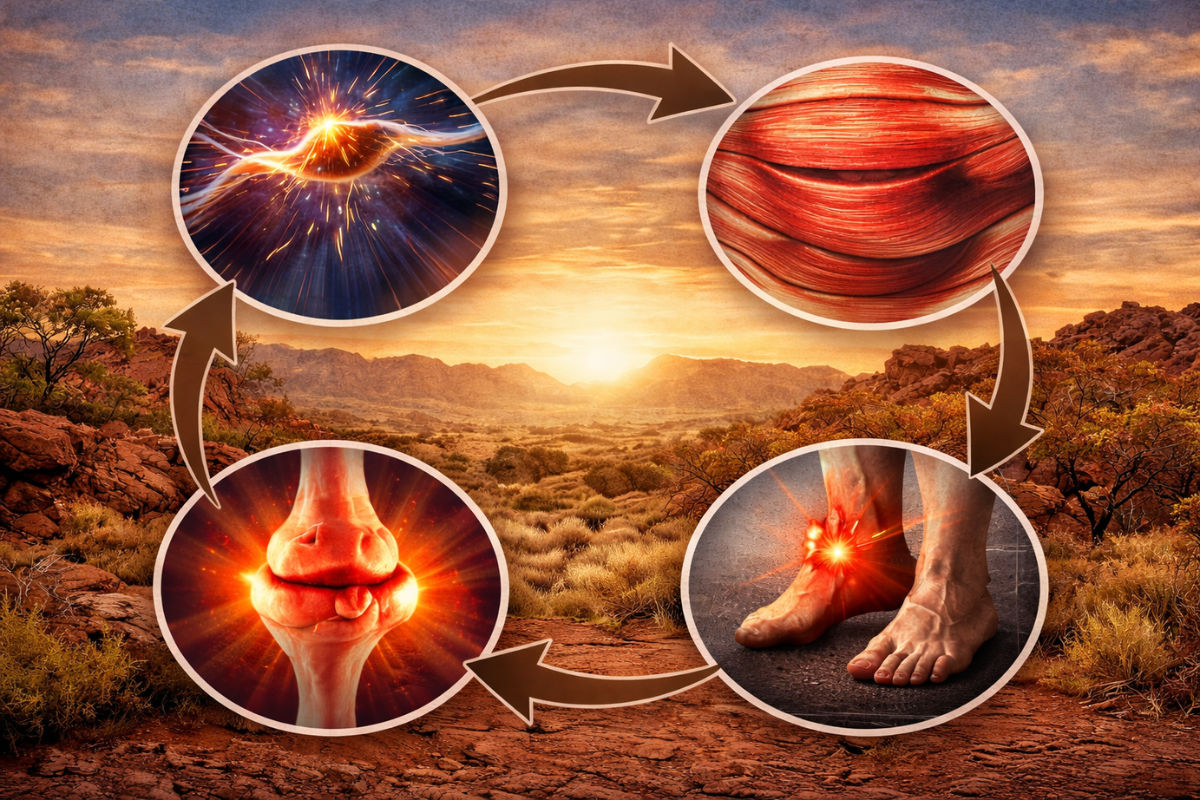
If you’ve lived with nerve pain, joint aches, or deep muscle discomfort for years, you’ve probably noticed the same frustrating thing I did:
Something helps — a cream, a stretch, a treatment.
The pain eases.
And then… it comes back.
I used to think that meant my body was just “breaking down.” Or that the pain was permanent. Turns out, it’s not that simple.
Most chronic pain hangs around because of a loop inside the body — your nerves, your muscles, and your circulation all feeding into each other. Once I understood that loop, I realized there are things we can actually do to start breaking it.
It’s natural to think of pain as coming from one spot:
“My foot hurts.”
“My knee is bad.”
“My lower back is killing me.”
But the truth? Long-term pain almost never lives in just one place.
When pain sticks around, your nervous system becomes involved. The nerves in the affected area stay irritated and begin sending repeated danger signals to your brain — even during normal movement or rest.
At the same time, the muscles surrounding those nerves respond instinctively.
They tighten.
This isn’t weakness or damage — it’s protection. It’s your body’s way of saying, “I’ve got this — I’ll brace things so nothing gets worse.”
Over time, pain becomes less about one joint or one nerve and more about how everything (your muscles, nerves, and circulation) interacts.
People like to blame stiffness on posture, aging, or not stretching enough. Sometimes that’s part of it, sure. But when nerves stay irritated, muscles tighten for a reason — they’re literally bracing the area.
Tight muscles:
Limit movement to protect sensitive nerves
Reduce sudden or unpredictable motion
Create a feeling of stiffness or deep aching
The problem? Muscles weren’t built to stay tight all the time.
When they stay tight, they begin to:
Compress surrounding tissues
Restrict blood flow
Increase pressure around already sensitive nerves
What started as protection slowly becomes part of the problem.
This is where the loop really locks in.
Tight muscles and guarded movement reduce circulation. Less blood flow means less oxygen and fewer nutrients reaching the area — and fewer waste products being carried away.
That environment encourages ongoing inflammation, which:
Sensitizes nerves even more
Makes tissues less flexible
Increases soreness and burning or tingling sensations
Those irritated nerves then signal danger again…
Which causes muscles to tighten further…
Which further limits circulation…
And the loop continues.
That’s why pain can flare up without a new injury — it’s your body stuck in the loop.
Hot packs, cooling creams, massages — they all feel amazing. And they do serve a purpose: they calm the nervous system temporarily.
That’s why relief can feel immediate. But if the loop — those tight muscles, irritated nerves, and poor circulation — stays intact, the pain eventually drifts back.
It’s not failure. It’s biology.
Quick fixes don’t fail because they’re useless. They fail because they weren’t designed to break the loop alone.
Long-term pain doesn’t respond to intensity. It responds to consistency.
Here’s the part I wish someone had told me years ago. You don’t need extreme routines, pushing through pain, or complicated exercises. You need to start sending the right signals to your body — slowly, consistently.
Pain teaches your body to fear movement. And after years of discomfort, that fear can be strong.
Start small:
Gentle ankle circles, foot flexes, or knee bends while seated
Short walks on flat ground
Light stretching that stops before pain
The goal isn’t to strengthen yet.
It’s to remind your nervous system that movement doesn’t equal danger.
When that message is repeated daily, muscles slowly stop guarding nerves so aggressively.
Muscles tighten to protect irritated nerves — especially in the feet, calves, hips, and lower back.
You can help them relax with:
Warm compresses to tense areas
Gentle massage around the tight spots (not directly on sharp pain)
Light stretches after warming up muscles
Muscles that feel supported instead of strained ease their grip — which can reduce pressure on sensitive nerves.
Reduced circulation fuels the pain loop. Better circulation = less buildup of inflammatory byproducts.
Try:
Standing or walking briefly every 30–60 minutes
Elevating feet if they feel heavy or swollen
Gentle pre-bed movement to ease stiffness
Even small boosts in circulation can help break the cycle of recurring pain.
Recovery isn’t a luxury — it’s how the body resets its baseline.
That means:
Consistent sleep times, even if sleep isn’t perfect
Short rest periods during the day instead of pushing through fatigue
Listening to pain signals early, before they escalate
Chronic pain often worsens when recovery is sporadic. Regular recovery helps calm the nervous system and reduces how intensely pain signals are sent.
Pain doesn’t ease because you do more.
It eases when you do the right things, consistently, in ways your body can handle:
The pain loop starts to loosen — and over time, your baseline begins to shift.
So, if you’re tired of the pain coming back again and again, start with these basics. Little consistent steps each day are what really make the difference.
— Mark
Stephanie Montgomery
January 21, 2026
My pain is so bad on my right side down to my foot shocking pain but I can say your products is the best I carry it with me I just want relive