
Your Cart is Empty

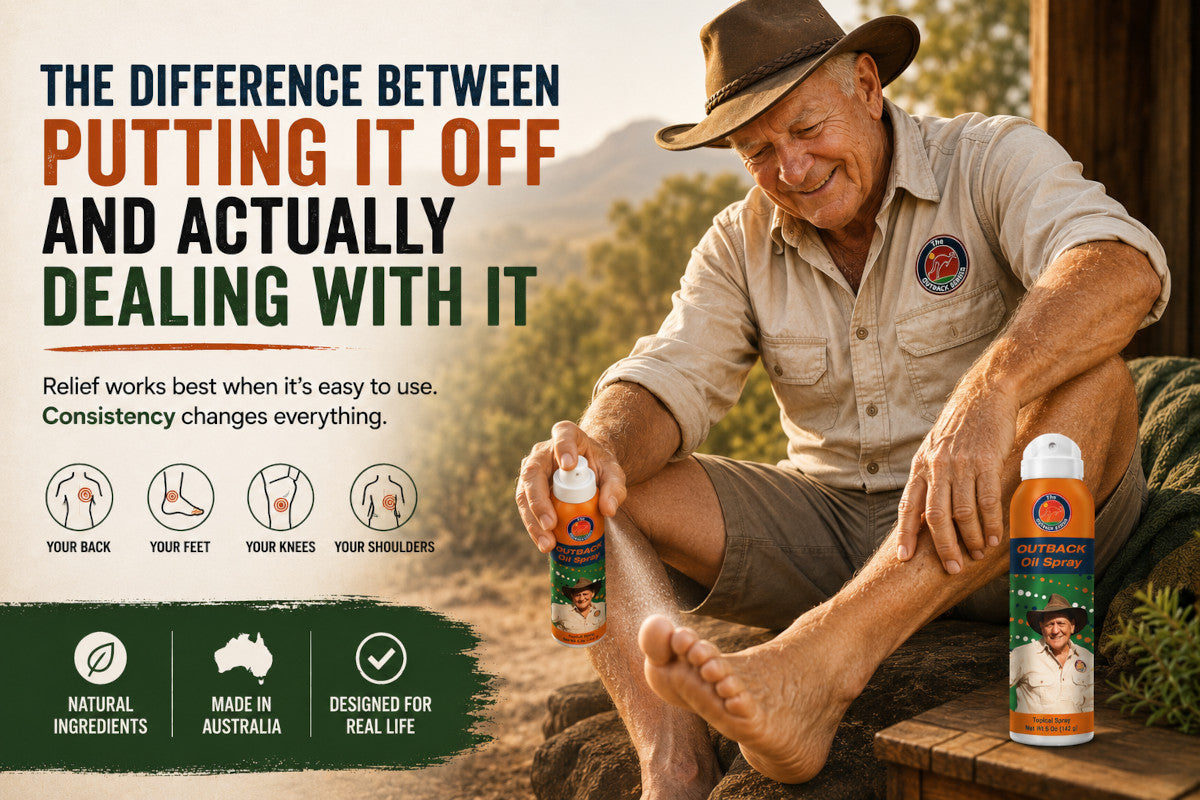
Most people dealing with chronic discomfort aren't ignoring it because they don't care. They're putting it off because dealing with it has become more effort than they have energy for.
Your back. Your feet. Your knees. These are the areas that come up most often. Not always because they hurt the worst, but because every solution requires something extra. More bending. More reaching. More asking for help.
And when something requires effort at the end of an already long day, it gets skipped. Not because you gave up. Because you're tired.
"The difference between putting it off and actually dealing with it usually comes down to one thing: how easy it is to do."
Friction is the gap between knowing something would help and actually doing it consistently. It's not a motivation problem. It's a design problem. When the solution is hard to use, it gets used less. When it gets used less, results are inconsistent. When results are inconsistent, people assume the product isn't working and stop altogether.
But most of the time the product was fine. The application was the problem.
Think about the specific friction points that come with hard-to-reach areas:
Your back
Reaching your lower or mid-back without help means awkward twisting, straining, or asking someone else to do it for you. Most people just skip it.
Your feet
Bending down at the end of the day when you're already worn out is the last thing you want to do. So the feet get ignored even though they've been working all day.
Your knees
Getting low enough to apply something properly means putting strain on the very joints you're trying to help. It's counterproductive before you even start.
Your shoulders
Reaching across your body or behind your back to apply something to your shoulder is awkward at best, painful at worst. Most people give up after a few tries.
Here's the part most people miss. Topical relief works best when it's used consistently, not just when the discomfort gets bad enough to push through the friction.
One application gives temporary relief. Daily application, in the right area, at the right time, is what starts to change the pattern. The nervous system gets consistent support. The tissue gets regular attention. And over time, the baseline shifts.
That's the difference between someone who says "it helps a little" and someone who says "I don't know what I'd do without it." It's usually not a different product. It's a different habit. And habits only form when the behavior is easy enough to repeat without thinking about it.

The Outback Oil Spray is the same formula as the roll-on. Same four ingredients, same maturation process, same relief. The difference is purely in the application.
A spray covers more surface area. It reaches places a roll-on can't without help. It doesn't require bending, twisting, or asking anyone for assistance. You point it where it needs to go and you're done in seconds.
That sounds like a small thing. But for a lot of people, removing that friction is what finally makes consistent use possible. And consistent use is what makes the difference.
"It's the best product I've ever had. Helps me so much with the sciatica in my legs. I finally got a subscription so I won't be without it."
Nathaniel W. — Verified Customer
"I use it on my back every day. I can reach it myself without twisting around or asking anyone for help. At my age, staying independent matters more than anything."
Robert M. — Verified Customer
"I love the spray. No more twisting around trying to reach my feet. I just spray and I'm done."
Cheryl C. — Verified Customer

Outback Oil Spray
150mL. The same 4-ingredient Australian formula. Easy to reach where you need it most.
Learn More →